
Built to Last. Sustainable Interiors That Preserve More Forests.
At Bethliving™, sustainability is not a feature or a certification. It is the very reason we exist.
A Better Home Should Not Cost
The World Its Forests
For decades, the home interiors industry has relied on plywood, MDF, particle board, and laminates — materials that face challenges with moisture, termites, swelling, and delamination. The result is a relentless cycle of repair, replacement, and resource waste.
Bethliving was founded to challenge that cycle — by engineering kitchens, wardrobes, and home interiors using Grade 304 Stainless Steel. Products designed not around replacement cycles, but around longevity.
70,000+
Trees Preserved Since Inception
100%
Recyclable Steel Construction
Zero
Wood. Zero PUF. Zero Compromise.
Our Sustainability Framework
Inherently Sustainable — By Design, Not Declaration
Reducing Timber Dependence
Every Bethliving interior replaces plywood, MDF, and particle board with stainless steel — reducing reliance on forest-derived materials without sacrificing beauty or function.
Ahimsa by Design. A home that needs no pest control is a home that causes no harm — a principle aligned with the values of Jain-friendly living.
- Zero Wood Zero PUF
Built to Last Decades
Products that resist moisture, termites, corrosion, and structural decay reduce replacement cycles — lowering lifecycle waste and resource consumption across millions of homes.
- Longevity by Engineering
Circular Material Recovery
Steel is among the world’s most recycled materials. Unlike composite wood products, Bethliving’s stainless steel can be recovered and recycled repeatedly — closing the material loop.
- 100% Recyclable Steel
Healthier, Pest-Free Living
Steel and stainless steel offer no harbour for pests. With Zero Wood and Zero PUF construction, Bethliving homes eliminate the conditions termites and insects need — removing the requirement for annual pest control treatments entirely.
- Ahimsa by Design
Precision Manufacturing
Our Harohalli facility focuses on efficient material utilisation, process optimisation, and waste reduction at every stage — minimising environmental impact beyond the product itself.
- Responsible Production
Pan-India Reach, Local Impact
Every home — from Kerala to Gujarat to Delhi NCR — that chooses Bethliving is one fewer home contributing to timber-intensive replacement cycles. Small choices, meaningful impact at scale.
- One Home at a Time
↗Bethliving Combi Deluxe SS304 Hygienic Utility Area Design
The Most Sustainable Interior Is The One That Doesn't Need Replacement.
A kitchen rebuilt every decade has a far larger environmental footprint than one engineered to serve generations. Bethliving interiors are built to resist the forces that defeat conventional materials.
- Water & Moisture Damage
- Termite Infestation
- Swelling & Delamination
- Warping & Structural Decay
- Corrosion
↗Bethliving Student Bedroom Design
Steel That Remains Valuable, Even at the End of Its Life.
Unlike plywood and composites that become landfill at the end of their lifespan, Bethliving’s Grade 304 Stainless Steel can be recovered and recycled without loss of quality — indefinitely.
This circular material lifecycle fundamentally changes the environmental calculus of home interiors.
- 100% Recyclable Steel
- No Quality Loss Through Recycling
- Reduced Lifecycle Waste
- Resource-Efficient Material Use
Our Long-Term Vision
A Future Where Beautiful Homes
Require Fewer Forest Resources.
Questions on Steel & Sustainability
Are steel interiors environmentally friendly?
Steel interiors are highly durable, 100% recyclable, and support a circular material lifecycle. Their longevity means fewer replacements over time — directly reducing waste, manufacturing energy, and transport emissions across a home’s lifetime.
Is stainless steel more sustainable than plywood or MDF?
Stainless steel offers significant advantages in durability, recyclability, and lifespan. Unlike MDF and plywood that swell, delaminate, and become landfill, stainless steel resists moisture and pests — and retains its full material value at end of life.
Do Bethliving interiors require annual pest control?
No. With 100% steel construction and a Zero Wood Zero PUF material policy, Bethliving homes offer no habitat for termites or pests. Annual pest control treatments — and the chemicals they involve — are simply no longer necessary.
Why do longer-lasting interiors reduce environmental impact?
Every replacement cycle consumes new raw materials, manufacturing energy, and transportation. An interior that lasts 30 years instead of 10 reduces that footprint by two-thirds — making longevity one of the most powerful and under-recognised forms of sustainability.
How does Bethliving contribute to sustainable living?
By creating Grade 304 Stainless Steel interiors that replace timber-intensive materials, lower replacement cycles, support full recyclability, eliminate the need for chemical pest treatments, and encourage responsible resource use — one home at a time.
Can Bethliving's steel interiors be recycled at the end of their life?
Yes. Stainless steel is one of the world’s most recycled materials. It can be melted and reformed repeatedly without significant loss of quality — making it an ideal material for a circular, resource-efficient economy.
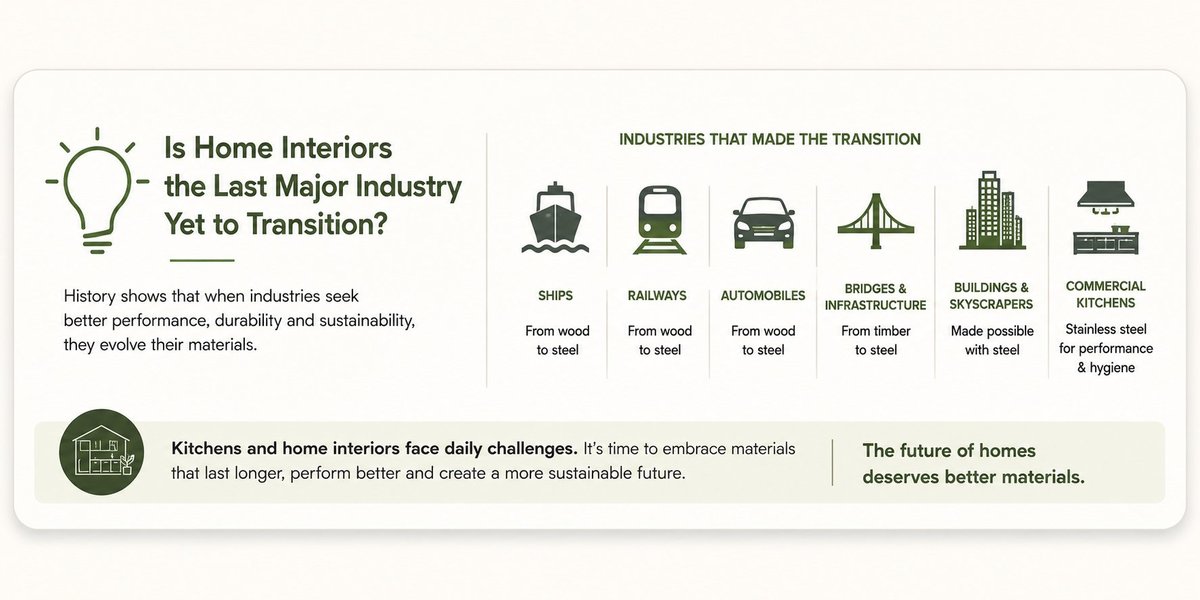
- Are Home Interiors the Last Major Industry Yet to Make the Materials Transition?
- Over the past century, ships transitioned from wood to steel. Railways transitioned from wood to steel. Automobiles evolved from wood-framed construction to steel bodies. Bridges, infrastructure, and skyscrapers followed the same path.
- These industries adopted materials that delivered greater durability, safety, longevity, and recyclability.
- The question is: why should kitchens and home interiors be any different?
The Bethliving™ Promise
Every Bethliving Home Is A Small Vote For Fewer Trees Cut — And Fewer Interiors Replaced.
When enough homeowners make that choice, small votes become meaningful change. That is the future we are building toward.